Contextual Essay: Mouthabet

Summary

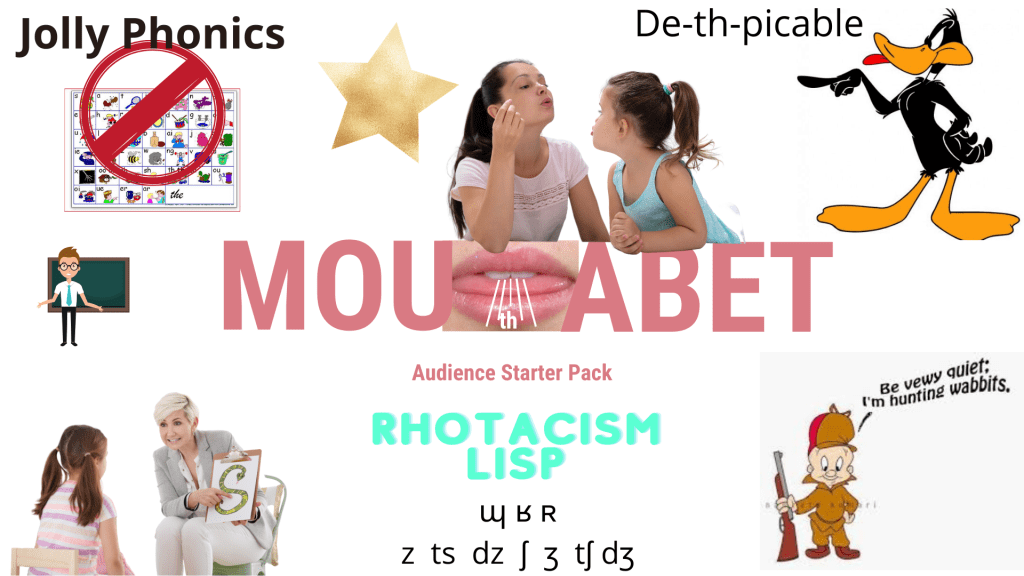
Mouthabet is a set of materials that are designed to support those who teach students to decode words and identify individual sounds and sound blends. The materials will help focus and engage students to discover the lip, tongue and mouth actions needed to produce specific sounds (phonemes) represented by letter shapes (graphemes). I wanted to share this resource that I created with those that it could benefit.

Website design took a large portion of time, however once set up, it fit into the FIST strategy. After noting the lack of website visitors, I decided to create a small community of like minded people on social media in an attempt to increase website traffic.

Through creating these social media channels, I thought I would be able to reach my niche target audience of teachers, tutors, parents and speech pathologists.
Learning moments

The main focus of the concept Mouthabet is sound production which involves lips, tongue, teeth, air expulsion, voicing and nasality. There are three main kits that are available for purchase online in a pdf format. The ultimate goal was to make this resource accessible to those looking for a visual aid to phonics.

  • Creating the social media pages noticeably increased traffic to the Mouthabet’s website. Over the course of this project, 74% of the websites traffic has been from the direct link through Facebook or Instagram. Over this period there have been 77 sessions on the website and 57 of those have come from social media. These sessions have an average length of 11 minutes. This reinforced that the layout of the website was effective enough to retain attention and for people to navigate through. It’s important to not though if the tab was left open and not used, this data still records this time.

As traffic increased, the Mouthabet website subscribers also increased in frequency and I am totalling at 14 subscribers as of now, as you can see I began the social media accounts in mid-July.

This emphasised how vital it was to keep engaging on social media to assist with reoccurring site visitors.

The Feedback I received from social media users and peers was to create a unified brand and aesthetic across all three platforms. This way, if traffic was directed from the social media pages, the website would seem familiar. A colour scheme and universal logo was selected. Consistency was something that was decided after feedback and the importance of unified branding was something that I further explored into through Coombers 2002 study into the definitions of branding. That it is more than just a logo. Mouthabet is now a persona heard through every caption.

The continuation of Mouthabet is something that is definitely on the cards. Currently the products themselves are being redesign and a video element is being utilised for a future prototype. Whilst doing this I plan to implement what I have learnt from my small following on social media and increasingly reach out to the target niche with engagement and hashtags.


Creating an audience in such a niche area is something that has been difficult as it’s not necessarily something that the BCM cohort wants to follow, however, the slow growth has been steadily increasing. The informational posts on the pages have been paired with longer engaging captions to hold the attention of my small audience. For the future trajectory of this artefact, reaching out to nano influencers in the education niche could be a proactive move in gaining recognition.

Sources

Coomber, S. (2002) Branding. Oxford, United Kingdom: John Wiley and Sons, Inc (ExpressExec Marketing). Available at: https://search-ebscohost-com.ezproxy.uow.edu.au/login.aspx?direct=true&db=nlebk&AN=66767

Ismail, K, 2018, ‘Social Media Influencers: Mega, Macro, Micro or Nano’, CMS Wire,  Simpler Media Group, Inchttps://www.cmswire.com/digital-marketing/social-media-influencers-mega-macro-micro-or-nano/#:~:text=That%20shape%20can%20be%20split,are%20really%20far%20more%20nuanced  

Zain, SZM, Hussin, ARC & Selamat, MH 2019, ‘Derivation of Hashtag (#) Factors for Hashtag Marketing Model (HASHMAM) in Social Media Platform’, 2019 6th International Conference on Research and Innovation in Information Systems (ICRIIS), Research and Innovation in Information Systems (ICRIIS), 2019 6th International Conference on, https://search-ebscohost-com.ezproxy.uow.edu.au/login.aspx?direct=true&db=edseee&AN=edseee.9073657


BCM113: Contempt of court and George Pell case

Director of Public Prosecutions v George Pell

By Laura Cross, BCM113

On December 11th 2018, in the case of  Director of Public Prosecutions v George Pell, Pell was convicted on five charges of sexual abuse. These offences dated back to 1996-1997 against two boys during Pell’s time as Archbishop in St Patrick’s Cathedral. The hearing was on the 27th of February 2019 where he was found guilty on all five charges and sentenced by Judge Kidd (2019) to six years, 3 minimum. This case has emphasised some inherent legal issues that the justice system in Australia faces, especially in relation to Australian Law of Contempt. DPP v George Pell ran alongside another case against Pell known as “the Swimmers Case” and due to  its nature, being both similar in charges and as high profile, a full suppression order was granted on 25 June 2018 to prevent “a real and substantial risk of prejudice to the proper administration of justice” by Peter Kidd. The effectiveness of the suppression orders, however, has been brought into the light in regards to both breaches made by professional media outlets and breaches made by the general public online. The case has made critics and professors question and rethink the “tangled web of restrictions” faced by journalists and social media users (Pearson, 2018, n.p.).

The way in which reporters, bloggers and other communications transfer information has changed substantially over time and this presents new issues for suppression orders. The prominence of individuals posting online is described by Barnes (2012) as citizen journalism, a form of journalism without professional training, that is enabled due to platforms on social media and websites. The nature of communication is instantaneous in this age, which brings up the question of whether the legal system needs to rethink legal devices such as suppression orders (Pearson, 2018). In relation to the Pell case, before the suppression order was lifted, there were articles published through international organisations out of Australian jurisdiction. A Victorian Supreme Court spokeswoman encapsulates the problems in this case  “Suppression orders may not be as effective as they were in the era where traditional media was the only source of information, but they do still have an effect, as the mainstream media is still the principal source of information for people.” Not only do we have the issue of global media scandalising the Australian court, but there was also a multitude of posts, particularly on Twitter, discussing and re-tweeting the international media outlets and therefore the majority of the Australian public knew the verdict before the Swimmers Case was dropped. This simply proved that it is not possible to contain details around high profile cases. The Law Council of Australia also called for an enquiry into suppression orders following the conviction and lawyer Nick Papas (2019) describes the high number of breaches as “unprecedented.” 

When media outlets are found in contempt of court, they can face a fine or even gaol time. A case that epitomises why journalists must take due care and be educated in laws surrounding contempt is the DPP v Johnson, Yahoo!7 2016. Yahoo!7 was fined 300,000 and Johnson was put on a good behaviour bond for disclosing evidence. This error is described as poor editorial skill and exemplifies the need for articles to be checked by people with legal experience before being published (Pearson & Polden, 2019). Parallels can be drawn from some of the 36 cases of contempt currently charged. This applies to the 36 journalists and media sources who have been charged, including the Herald Sun, Macquarie Media Limited and Ray Hadley. 

On the 15th of April, during the court hearing for the media, Dr Matt Collins QC told the judge “these respondents are not fringe players, these are mainstream players.” Dr Collins represented the media outlets and was attempting to highlight in court the new territory the legal system is facing. The case will be postponed until June. The lawyers for the 36 held in contempt told the hearing that it would have a “chilling effect” on open justice, as none of the publications mentioned his name or charges. Opposing this Justice Brennan (2019) stated “this is not the only hallmark of a free society and, sometimes, it must be restrained by laws designed to protect other aspects of the public interest.” As implemented on October 2013 when  Derryn Hinch was found guilty of breaching a suppression order and was fined $100,000, and spent 50 days in jail which he described as draining and “a sick joke” (Hinch, 2014, n.p). The Director of Public prosecutions (2019) stated that 34 cases “had a tendency to interfere with the due administration of justice in the prosecution of Pell.” The 36 are also being accused of “aiding and abetting the overseas media’s contempt” and that 16 scandalised the court. 

The legal attribute of ‘open justice’ is a principle of common law in Australia, that means a court is open to public knowledge. In cases such as DPP v Pell it is essential to find the balance of public interest in court with the right to a fair trial (Moses, 2019) as expressed by the Law Council president with his call to a review. A supreme court spokeswoman emphasised, after the Pell case, the discretion and tailored consideration given to suppression orders and how they are a necessity for a fair trial in some cases. The expression of worry, by those held in contempt at the hearing, in relation to the future of open justice once the contempt case is tried has failed to recognise that mainstream media had the opportunity to challenge the suppression order under the Open Courts Act 2013 (Bosland, 2019). 

Contempt of court was established to allow a fair trial within Australia’s legal framework, having consequences for the media is necessary to achieve open justice. Despite procedures established for traditional media, the introduction of  ‘citizen journalism’ and global reach has undermined the suppression order in George Pell’s case. There are grey areas when it comes to defining who is and isn’t culpable on social media platforms when disclosing and discussing Pell prior to the suppression order being lifted. It is inherent that reform is required to resolve this. For professionals in the journalism industry, there should have been editors that highlighted the risk of being held in contempt due to certain publications, especially after no challenge was made to the order. In June the contempt case for the media coverage of Pell’s trial will continue and if they follow trend of other similar cases there will be hefty fines and potentially goal time.


Reference 

Barnes, C. (2012). Citizen Journalism vs. Traditional Journalism: A Case for Collaboration. [online] University of the West Indies, 2012., pp.1-5. Available at: https://eds-a-ebscohost-com.ezproxy.uow.edu.au/eds/detail/detail?vid=4&sid=cb6c085e-a6b7-4bb8-a38f-813e73ec8a32%40sdc-v-sessmgr04&bdata=JnNpdGU9ZWRzLWxpdmU%3d#db=edsjsr&AN=edsjsr.41708775 [Accessed 11 Apr. 2019].

Pearson, M. (2018). Why the public isn’t allowed to know specifics about the George Pell case. [online] The Conversation. Available at: https://theconversation.com/why-the-public-isnt-allowed-to-know-specifics-about-the-george-pell-case-93651 [Accessed 15 Apr. 2019].

Pearson & Polden, 2019, ‘Chapter 5: Contempt of Court,’ The Journalist’s Guide to Media Law 5th Edition, Allen & Unwin, Sydney, Australia, p. 156

Tomazin, F. (2018). Open justice or the suppression state?. [online] The Age. Available at: https://www.theage.com.au/national/victoria/open-justice-or-the-suppression-state-20180624-p4znd4.html [Accessed 16 Apr. 2019].

The Newsmakers, (2019). [TV programme] 881: Sky.

[2019] VCC 260

Click to access dpp-v-pell-sentence-2019-vcc-260.pdf

Australian Law Reform Commission, Report No 35: ‘Contempt’ (1987), summary at page xxx, New South Wales Law Reform Commission

Warren, M 2014,OPEN JUSTICE IN THE TECHNOLOGICAL AGE’, Monash University Law Review, no. pp. 45-47


BCM110: Marketing Meets Memetics

Introduction

This report will delve into the influence that memes have had on viral advertising and why this is a marketing strategy for many businesses. Marketers with memetic understanding are empowered to fill and manipulate consumers at their own discretion (Williams, 2015). Its is not just the volume of reach of viral marketing but the content, as it must resonate enough to push a purchasing action.

Literature Review

Russell Williams (2005) “Memes: Memetic possibilities for marketing management” in the academic journal “Management Decisions” is an academic source that encapsulates how the concept of memetics has evolved into contemporary marketing campaigns. It brings a new and practical approach as opposed to Dawkins book “The Selfish Gene” and the two complement each other when exploring how marketing campaigns effectively use memetics. Dawkins insight to the evolution of “replicators” in a DNA and cultural context provides basis of understanding how memetics apply to effective business communication.

Neither of the texts aforementioned discusses the rise of the internet meme as an “asset to a brand” as well as Russel Murray in The “Routledge Companion to the Future of Marketing” in chapter 18. Murrays test is supported by the 2018 Yellow Social Media Report with the statistical data of the frequency millennials access their social media. The Sensis also provides information on businesses online advertisements. Hanstedt and Russ’ “Designer Complex Memes and Hooks Increase the Value of Brand Equity” looks closely at the results of using this style of advertising and if it is effective. All other sources are examples of memetic advertising in action.

Results /Discussion

Richard Dawkins in his book “The Selfish gene” (1976) first identified the meme as an agent for cultural transmission, he later clarified in a 2015 interview with Wall Street Journal the process of this transmission from “brain to brain” out into the media then back to the brain, acting as a “replicator.” It is vital for businesses to understand the influence memes can have with internet culture and how they are implemented into various parts of present life aside from intuitive appeal.

There are the two main reasons why memetics are effective when adopted into marketing, the mass media approach reaches large amounts of people with lower costs than traditional advertising (Hanstedt & Russ, 2004), and the extent that replicators can successfully resonate in a consumer’s mind. Social platforms are increasing in popularity. These platforms work as exposure for marketing campaigns and where Dawkins (1976) concept of memetics meets practicality. This virtual space allows for the “horizontal transmission of memes” (Murray, 2014, p. 339). Murray (2014) highlights this horizontal transmission as the element that allows for the mass distribution of advertisements, as prior to this memes were replicated vertically from “parent to child” on a lower scale  (Murray, 2014, p. 339). Despite social media being an enabler for the mass distribution of memetics (Hanstedt & Russ, 2004), only the best memes will be successfully imitated on the basis of “learnability” and “infectiousness” (Williams, 2000, n.p). 

Williams (2005), Murray (2014), and Hanstedst (2004), all identify at points in their academic sources; the importance for marketers and businesses to understand their media audiences due to the expansion of social media. The 2018 Yellow Social Media Report discovered that 99% of Australian 18-29-year-olds were on social media and that 41% of 30-39-year-olds followed businesses and brands. The target audiences are young to middle-aged adults and therefore it is important for a brand to assess it’s relevance to internet memetics, for example, a chemist will not attempt a viral marketing campaign for arthritis medication. Interestingly two-thirds of consumers are more likely to trust a brand that interacts positively on social media. With this in mind, a positive presence online is a vital element in creating successful contagious memes.

Once an understanding of the media audience is established, marketers are able to focus on creating memetics that are “better survivors in the cultural world” (Williams, 2000, n.p.). Although all study results into memetic engineering are speculative, a pinnacle example of memetic advertising is KFC’s computer-generated influencer and a take on Colonel Harland Sanders. The marketing campaign is a parody of the fame individuals and brands seek to obtain. The campaign pushes the hashtag “recipe for success” on Instagram as it is tattooed on his torso. This meme has been so successful that the fake influencer has collaborated brands like Dr Pepper and Casper as a result, and the spoof has proven to resonate with consumers as they comment interact and share the meme (Wohl, 2019). This exemplifies how self-replicating ideas do not have to be engineered the surrounding product or brand truths, the parody acts as what Williams (2000) describes as a “hook” because the consumers can ‘poke fun’ at people that achieve this status through the KFC brand.

An advertisement done by Heineken exemplifies the misuse of these hooks and how the decoding of a message can be distorted due to cultural differences (Hanstedt, 2004). Heineken was attempting to attach an authentic connotation to the beer and did so successfully in Italy, however, as Williams (2000) highlights in Greece the meme of “Heineken is an ordinary beer” and settling for less was transmitted. This contradicted its luxury positioning and displayed the importance of understanding audiences cultural context. This concept extends in relation to all signs within the construction of memetic marketing and emphasises the negative effects as memes and marketing are is still in “infancy” (Hanstedt, 2004, p.g. 35).

Conclusion /Recommendations 

The concept of memetics has developed substantially since its introduction in 1976 by Dawkins. Businesses have been trying to use and refine it throughout their marketing to push a certain transmission. If not presented correctly it has been proven extremely difficult to redeem through damage control as memes are self-replicating in an exponential manner. This report has determined that the strategy is not yet mastered, however, if implemented that environmental and audience research on if the encoding of an advertisement is necessary to achieve intended interpretation. This in turn with virtual spaces providing platforms for the infection of memes from one mind to the next has the potential to create a widespread, but ultimately and presently unpredictable marketing campaign.

References

Dawkins, R. 1976, The Selfish Gene, Oxford University Press, Oxford.

Dawkins, R 2015, Cultural Meme, The Wall Street Journal, 29th of September, 4th of May, <https://www.wsj.com/video/richard-dawkins-on-the-cultural-meme/5C1154F8-36EB-4797-AFE9-C60226055FB1.html>.

Murray, N 2014, The Routledge Companion to the Future of Marketing, Routledge, 711 Third Avenue, New York, NY 10017.

Hanstedt & Russ, 2004, Marketing Memetics: Can the Use of Customized “Designer Complex Memes”and Hooks Increase the Value of Brand Equity, U. of Wisconsin, Green Bay. 

Williams, R 2000,  The business of Memes: Memetic possibilities for marketing management, Management Decisions, vol. (38), no. (4), pp. (272-279).

<https://eds-b-ebscohost-com.ezproxy.uow.edu.au/eds/detail/detail?vid=1&sid=3494c314-a721-4d92-ab8d-45624301500c%40sessionmgr120&bdata=JnNpdGU9ZWRzLWxpdmU%3d#AN=2009-20279-006&db=psyh>.
Wohl, J 2019, KFC Pokes fun at instagram influencers with Colonel Sanders version, Ad Age, 9th April, 10th May, <https://adage.com/article/cmo-strategy/kfc-pokes-fun-instagram-influencers-colonel-sanders-version/2163246>.

We all Interpret Uniquely – Complex Image

“Love is in the Bin” –Banksy

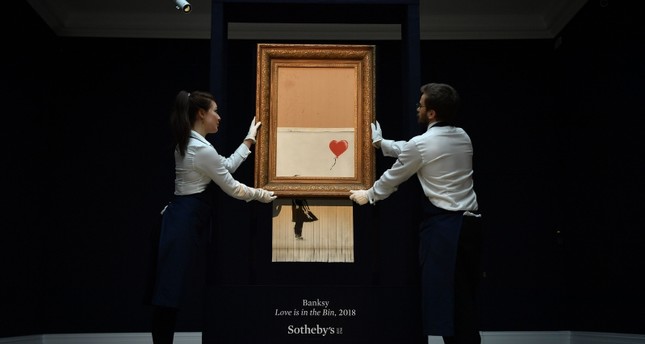
When looking at this image what we see and what we are interpreting are subjective and usually different from the author’s intent. Before we dive into the encoding and decoding of this image. What do we see? What are the denotations? This is a picture of a of a representation of a red balloon and seemingly half a girl drawn on a piece of paper. The image of the drawing is shredded from a gold frame. Without context or knowledge of the setting or artist this painting could be interpreted in a multitude of ways; As the girls face and upper body is covered she could be watching the balloon leave happily, hopefully reaching or sadly falling from the frame or escaping, it is almost limitless.

“Girl with Balloon” – Banksy

When people ‘read’ an image, it depends on what they’ve already been exposed to as explained in the Encoding and Decoding Model (Hall, 1973). The artist of the piece ‘Love is in the Bin’ is a well known street artist from Bristol, Banksy. Originally it was believed that his arguably most renowned piece, ‘Girl with Balloon” was up for auction. But just as the final bid was accepted ‘Girl with Balloon” was shredded and “love is in the bin” was created. Banksy claims that the whole image was meant to be shredded in its entirety, however, I am a strong believer that art is arbitrary and once it is completed by the artist, audiences have free-reign to interpret the ‘signs’ they see. Art Historian and Professor ‘Preminda Jacobs’ highlights in her understanding the subversive message she receives and recognises the “guerrilla tactics” that express the “disdain for the critics, dealers, gallery owners and museum curators whom they depend on for their livelihood.” (Jacobs, 2018) In which case others could interpret hopeless irony to the fact that critics suggest that the artwork has doubled in price.

People in white gloves holding Banksy’s work

I receive similar connotation of an attempt to reject the system and highlight the obscurity that street art is being handled and embraced as fine art. Particularly through the signifier of the large gold frame, evoking concepts such as wealth and superficiality. When juxtaposed with the illegitimacy of the shredded work it does highlight the artists attempt to push social messages by undermining the profitability of this work. However, with the context of the increased price surrounding the newly established work other connotations such as the impossibility of beating a system that embraces this subversion can also be drawn.

Banksy

References

Jacobs, P. (2019). Banksy and the tradition of destroying art. [online] The Conversation. Available at: https://theconversation.com/banksy-and-the-tradition-of-destroying-art-104810 [Accessed 28 Mar. 2019].

News Corp Australia Network (2019). Banksy buyer breaks her silence. [online] NewsComAu. Available at: https://www.news.com.au/world/europe/banksys-shredded-girl-with-balloon-renamed-love-is-in-the-bin-says-sothebys/news-story/f5a2143c58c694661901dd35dbb459b3 [Accessed 2 Apr. 2019].

Shoot, B. (2019). http://fortune.com. [online] Fortune. Available at: http://fortune.com/2018/10/08/banksy-girl-with-balloon-self-destructed-video-art-worth-double/ [Accessed 27 Mar. 2019].